Monday, December 27, 2004

Fwd: Washington Cruiser Flag // Flag Bulletin #206 article discrepancies...need clarification...

Actually email dated 2007 not 2004, just redated it so to put it on the blog, but at the end so other post more designed to the casual reader might be at or near the top of the blog...

Dear Dr. Whitney Smith, 


Again thank you for your email from your Flag Research Center earlier today.  I am glad to be a member since October and being told of your fine work by Peter Ansoff, president of NAVA, an organization that I see you served as president for a decade before and during our Nation's Bicentennial.

I just added Peter Ansoff to my contact manager program and the program then indexed my past emails to and from him.  Here below is one email from him dated 14 May 2006 where Mr. Ansoff first mentioned your Flag Bulletin article about an existing tree flag.  

In his 2004 Raven article on page 20 he credits your scholarly insight with the following quotation:
"…Original research is time-consuming and demanding and it's easy to assume that published sources are correct and can be trusted."

That is why I am devoting my time into this demanding work because you have the reputation of a flag expert.  While some non-scholars might call such time-consuming and demanding research evidence of "obsession", truth is a value to be upheld, like we hold up a flag we honor.
 
The quote from you by Ansoff in his article continued:
"Those who have written books and articles or have created web sites about American flags have for the most part relied on work done by Preble.   As a result there is a constant repetition of misinformation that gives certain designs the impression of accuracy."

I am working hard to end the repetition of misinformation, and in a collegial manner with you and others approach accuracy as best as the existing facts along with "educated guesses" may allow.  As a former Navy cryptologist, I like facts, but also accept the necessity to "the mission" of projection of designs from fact patterns and related applicable information.  

The maxim is "Don't let the perfect be the enemy of the good."  While absolute assurance of the one design is improbable if not impossible because different ships may have had slightly differing shapes of the components of the  approved flag design, an "educated guess" is quite reasonable.

Last year I communicated with David Martucci who lives in Washington, Maine and served as President of NAVA from 1998 to 2004, and he indicated that Preble tried to correct his error on the Snake flag between his 1872 book and his 1880 book.   However, Mr. Ansoff below indicates that may have been only one multi-colored stripe design of the several Snake on Stripe flag designs.

This related solely to the red and blue striped version of the rattlesnake flag, not to the "First Navy Jack" story per se.  I've done some further research since the article was published, and I believe I've found the source that Preble was actually referring to.  It was in a history of Philadelphia that was published in the mid 19th century. 

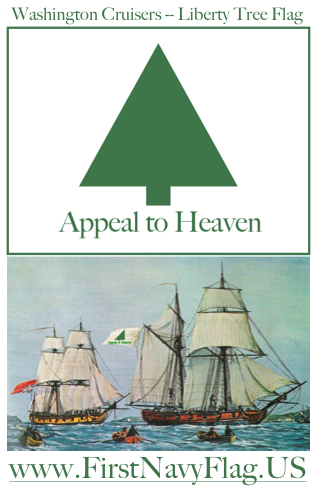
I am trying to work with you to minimize the misinformation pertaining to the Washington Cruiser Flag as may be best to describe the flag to differentiate it from the Massachusetts Navy flag, and establish some design particulars.
After Mr. Ansoff was in his new home and I wrote to him again this past 2 September 2007, to which he responded the very next day and he again mentioned your Flag Bulletin and the specific issue number #206.  I then contacted you in late October to purchase the Flag Bulletin #206.  I read your Flag Bulletin several times before I wrote to you for clarifications.

 > Do you know of any existing real or realistic copies of the "Bunker Hill" or Continental Flag in museum or personal collections? 
 
A flag similar to the purported "Bunker Hill" flag was found in private hands in New York a couple of years ago -- there was an article about it in "Flag Bulletin."  As I recall, it was believed to be a militia color from the 17th or early 18th century.  The "tree" in the canton was just a simple triangle, without any trunk or branches.  Again, my reference is packed up so I can't verify the details at the moment. 

In the illustration of that flag in the article on page 149, it shows a simple trunk in addition to the triangle for the tree.  The photograph of the flag on page 143 is hard to discern, I believe I see a triangle AND a trunk, though I am not sure.  Do you have a email address for Gary Laube to verify?

The new fact that had otherwise only presumed was on page 143 third paragraph, "...contained a small green wool triangle resembling a pine tree".  The letter of Colonel Joseph Reed obtained from the Library of Congress does not mention the color or the shape of the tree he mentions.  One would logically presume a green piece of fabric to represent a tree.

On the color page on page 144 are shown ten flags, five flags with a tree upon them, four in the canton, one on a white flag.  One flag, J, is not mentioned in the article text on page 145.  Yet there are four branches on either side of the centerline of each tree on page 144, and what appears as a patch of grass at the base of the trunk of the tree, NOT a simple triangle for the tree and a simple trunk as the illustrator reproducing the original Southhold flag shows on page 149.  

On the inside front cover (page 126?) is written "Artwork for this issue, courtesy Terri Malgieri".  Does the artist have some additional scholarly source for the eight branched tree, four on each side, as illustrated on page 144, or for the different design on the cover a MUCH more elaborate tree with 12 branches, six on either side of the centerline, with dozens of nearly individual leaves depicted, versus the simple triangle tree described, photographed, and illustrated in the article of Flag Bulletin #206?  

While the elaborate trees are impressive for illustration in a modern magazine, again I think logically and say,  

"Consider. You are a flag maker 222 years ago. You have to hand-stitch the "tree" onto the flag" (not silk screen a design on the fabric or print on paper). "A simple triangle is VERY MUCH MORE easy to stitch on the flag than these other elaborate designs.  A simple triangle shaped tree would convey the concept, take less time, less thread, and be far more likely to withstand the stress of the flag flapping in the winds that a Navy flag would experience..."

Grammar causes questions in the last two paragraphs on page 145 of Flag Bulletin #206.
(1) First is written "The pine tree... was a natural choice in 1776 when Massachusetts-Bay sough an official ensign for its Navy."  Time wise that is a correct statement for Massachusetts did, in 1776, adopt the simple tree flag, or pine tree flag, as its Navy Ensign, after the autumn of 1775 adoption of a similar but not the same flag design.

(1.a) Confusing or in error is the next sentence about "George Washington's secretary, Colonel Joseph Reed, proposed the same ensign for the Continental Navy."  Time wise Colonel Reed proposed a similar flag on 20 October 1775, months before Massachusetts adopted a similar tree flag.

(1.b) However there was a significant design difference between the Washington's aide Colonel Reed proposed design that included the motto "Appeal to Heaven", and the Massachusetts Navy flag which to the best of my knowledge from reading, did not include the motto.  

(1.c) Is there any design information as to the shape of the tree in the Massachusetts Provincial Congress records (or the exclusion of the motto) on the Massachusetts Navy flag as was used on the flag flown by the Continental Navy ships commissioned by Commander in Chief Washington?

(2) The Flag Bulletin article on page 145 continues: "While that idea was never approved, it may have appeared in an American ensign displayed by John Paul Jones."
That sentence creates two issues, a concerns and a question:  

(2.a) First, the 6 January 1776 letter by Admiral Hugh Palliser describing the Continental Navy ship Washington ensign captured when the ship went aground and was captured by the British confirms the design described by the 20 October 1775 Colonel Joseph Reed letter was "approved" by its use on American Continental Navy ships.

(2.b) Second, what is the citation for John Paul Jones flying a tree flag?  I have read that he raised the first "Grand Union" flag of the Union Jack as a canton on the Sons of Liberty red and white stripes flag.

(3) The next paragraph states:  "A flag of 13 white, blue, and red stripes with a white canton bearing a green pine tree appears in a circa 1776 painting of his personal arms."  

(3.a.) Who is meant by "his"?  Does "his" in "his personal arms" refer to John Paul Jones, or Colonel Joseph Reed? 
(3.b) Where is the 'circa 1776 painting' and what is its provenance, or to say, is the artist much more reliable than English artist Thomas Hart?

(4) The next to final sentence on that page states:  "As an ensign that flag (cover) would have been paired with the Pine Tree Flag (I) as a jack." [Referring to page 144, illustration I. ] 

(4.a) The design of the tree on the cover and the design of the tree on page 144, illustration I are not the same.

(4.b) The pairing between the flag and the Navy jack would be the flag in page 144, illustration J with illustration I.

(4.c)  While illustration J is not mentioned in the article, some claim it was used at Bunker Hill, or Continental Flag, and so called the Bunker Hill flag.  Do you have any basis to support or refute that notion or legend, other than the later painting by Trumbull?

(5) The final sentence states: "It might have been used as an alternative to the Continental Colors, although there is no evidence of such usage."

(5.a)  The Navy jack flag would derive naturally from the Continental Flag (or Bunker Hill Flag) if such existed.  The terms Continental Flag and Continental Colors seem to be one and the same.

(5.b) However, when the Grand Union flag was hoisted, with its canton being the same as the British Union Jack a problem was created for the Continental Navy because the Navy has the tradition of using the canton of the national colors as its Navy Jack.   Is that your understanding of Navy Jack flag tradition?

(5.c) Based on Admiral Palliser's 6 January 1776 letter, with the modified with motto Continental Flag canton on the Continental Navy ship Washington, there is "evidence of such usage".

Working together we can overcome misinformation, and seek a studied version of accuracy in the design of an important flag in American History.

A closing question given that you were President of NAVA for the years prior to the Bicentennial years of 1975 and 1976, did any officers from the Secretary of the Navy offices or historians from the Naval Historical Center ever consult you on which flag was an historically accurate Navy flag at the time of the founding of the Continental Navy in October 1775 versus the prevailing legends?

For America's future (building up on our past),

James Renwick Manship
Interpreter of George Washington (in Three Dimensions)
Box 75, Mount Vernon, Virginia 22121
202-657-6760

Quote from 1770, retired Virginia Militia Colonel 
George Washington said:

"As our country grows, and its population increases, as it will,
care must be taken to have each succeeding generation know
the trials and tribulations of those who preceded them.
History is an essential study to better government."

Begin forwarded message:

From: "Peter Ansoff" <ansoff@alumni.vanderbilt.edu>
Date: May 14, 2006 10:13:24 AM EDT
To: "'James Renwick Manship, Sr.'" <George@WashingtonLIVES.us>
Subject: RE: Navy Flag

Dear James,
 
Unfortunately, I don't have access to my notes and reference library right now, because they're all packed in boxes (we're getting ready to move to a new house, after 19 years in this one).  I've made some comments on your questions below "off the top of my head" -- sorry that I can't be more definitive.

 > Do you know any existing copies of that Liberty Tree flag that flew on any of those water borne vessels? Either in museum or private collection, here or in England? 
 
As far as I know, no original example exists, anywhere.  The only first-hand illustration is in a British engineering officer's sketch of one of the floating batteries. 

> What do you make of the "Norfolk Pine" -extended thin branches? Where did that come from? 
> I see various shapes of the evergreen, or pine tree. Do you have any knowledge as to what shape was most prevalent? 
 
The most common 18th-century version seems to have had separate branches that were either horizontal or at about 45 degrees to the trunk. The "Buck flag" is a good example, and others appear on contemporary coins, currency, documents and cartoons.  I don't believe I've ever seen an 18th century illustration that looked like the modern "Christmas tree" version.

 > Do you know of any connection between the Buck Flag, that was reportedly presented to a black regiment by Hancock and Washington? 
 
As far as I know, the whole story of the Buck flag is an unattributed legend that first appeared in a 19th century book.  The flag itself is at the Massachusetts Historical Society, but I don't believe that they have any information about its origins.   The supposed connection with Hancock and Washington stems from the fact that the scroll above the device has the letters "JH" and "GW."  If I had to guess, I'd say that the flag probably dates from the early years of Washington's term as president, when Hancock was governor of Massachusetts.  The idea might have been to imitate the British practice of putting the royal cypher on regimental colors by displaying the initials of the President and the Governor.  That's just pure speculation, of course -- I haven't looked into the story of the "Buck flag" in any detail.

 > Are there any elements of that Buck flag that derive from Hancock, such as the deer, the colors, the inscription, or its "Linus-type-pitiful" tree? 
 
See above.  As far as I know, there is no documented connection between Hancock and the flag.   

 > Do you know of any existing real or realistic copies of the "Bunker Hill" or Continental Flag in museum or personal collections? 
 
A flag similar to the purported "Bunker Hill" flag was found in private hands in New York a couple of years ago -- there was an article about it in "Flag Bulletin."  As I recall, it was believed to be a militia color from the 17th or early 18th century.  The "tree" in the canton was just a simple triangle, without any trunk or branches.  Again, my reference is packed up so I can't verify the details at the moment.  As I mentioned in the last email, the consensus among those who have studied the issue is that the "Bunker Hill" flag was not used after the early 18th century.  The term "Continental Flag" is usually used to refer to the Continental Colors -- stripes with the British union in the canton.

 > I ordered through Inter-Library Loan your Raven article, but never received it. I received a copy and read through it with much interest. Well  done. 
 
Thank you.  It was interesting and fun to research.
 
 > Was curious about the indicators that the European artists may have intended to be demeaning with their illustrations of the rattlesnake on its belly.
 > You did not go too deep on that, how significant do you think that possible intent may be? 
 
I didn't really look into that in detail because it wasn't the focus of my research.  It would be an interesting topic to pursue.   Good references to start with would be Lester Olson's book "Emblems of American Community in the Revolutionary Era," Karen Cook's article on the rattlesnake emblem, and Cresswell's "Drawings and Prints"  (the last two are cited in the "First Navy Jack" paper).

Do you have any conclusions of how the Admiral Preble 1872 error, and his significant efforts later to correct the error by insistence in the removal of text discussing the flag, but publishers failure to remove the color plate of the Snake flag, contributed to the continuation, or even the extension of the Navy Flag legend? 
 
This related solely to the red and blue striped version of the rattlesnake flag, not to the "First Navy Jack" story per se.  I've done some further research since the article was published, and I believe I've found the source that Preble was actually referring to.  It was in a history of Philadelphia that was published in the mid 19th century. 

Since the above paper is not published, do you have an email version that I might read to extend my understanding? 
 
Right now it doesn't exist in a "digestible" format.  Once I get the move behind me, I plan to get busy and prepare it for publication. 
 
Best regards,
 
Peter Ansoff


Friday, January 21, 2000

Re: Washington Cruiser Flag / This Day in History 1779: Henry Laurens named minister to Holland

Dear "General Cornwallis", 

Thank you so much for your reply.
Greenwich did reply with a copy of the letter from Admiral Sir Hugh Palliser, but did not have any clue as to where the Washington flag might be.
Other folks suggested something or other "Peerage" as a means of tracking down the current families of Palliser, Lord Sandwich, and the family of the Admiral who received the Washington Cruiser flag as a gift of his son, the ship captain who captured the flag when the Washington went aground while being pursued by the British warship.  What do you know of that Peerage publication and process?
Based on your comment, I have discovered the following, that I shall research further for General Washington...

For America's future (building up on our past),
Aide to GW
James Renwick Manship
Interpreter of George Washington (in Three Dimensions)
Box 75, Mount Vernon, Virginia 22121
202-657-6760
Quote from 1770, retired Virginia Militia Colonel 
George Washington said:
"As our country grows, and its population increases, as it will,
care must be taken to have each succeeding generation know
the trials and tribulations of those who preceded them.
History is an essential study to better government."


On AD 2008 January 21 Day:021, at 9:51 AM, Howard Burnham wrote:
Dear General Washington,
 
Good to hear from you. I am sorry that you have not heard back from Greenwich. My old history professor was a governor of the National Maritime Museum and author of the definitive bio of Admiral Lord Rodney. Alas. he has gone to glory. I wonder if you have access to a research library that has The Gentleman's Magazine of London on microfilm. That has a wealth of information on daily life in the capital during the 18th century.
 
Huzza,
 
Cornwallis
 

From: James Renwick Manship [mailto:George@WashingtonLIVES.us] 
Sent: 20 January 2008 21:35
To: Howard Burnham
Subject: Re: This Day in History 1779: Henry Laurens named minister to Holland / RevWar Battle of New Orleans
 
Dear Lord Cornwallis, 
 
I just found this fine communications of many months ago.  My apologies for system failures, likely the primary one above my shoulders...
 
How are you my fine sir?
 
By the way, might you know of the Washington Cruisers flag captured when the Washington went aground and captured by her British pursuer?  THere are reports that it was paraded through the streets of London.  
 
I made simple inquiries at the British Museum and the National Maritime Museum, yet sometimes what is most needed is a "home boy" who knows how to ask the right question to the Home Office...
 
For America's future (building up on our past),
 
James Renwick Manship
Interpreter of George Washington (in Three Dimensions)
Box 75, Mount Vernon, Virginia 22121
202-657-6760
 
Quote from 1770, retired Virginia Militia Colonel 
George Washington said:
 
"As our country grows, and its population increases, as it will,
care must be taken to have each succeeding generation know
the trials and tribulations of those who preceded them.
History is an essential study to better government."


On AD 2007 October 22 Day:295, at 4:03 PM, Howard Burnham wrote:


Your Excellency will recall that an officer who has given his parole, unlike a civilian like Mr. Laurens, does not need what you charmingly style "hosted" accommodations. I remained with my military family in York until the R.N. sloop Bonita could take me to New York for a somewhat painful interview with Sir Henry Clinton before proceeding to England. The Comte de Rochambeau you will recall kindly advanced me ten thousand livres with which I was able to facilitate my departure – noblesse oblige as the French so graciously put it. I was able to, you will recall, to entertain Your Excellency and staff to dinner, where I observed that "when History recalls the distinguished part that Your Excellency has played in the recent conflict, it will always record that you won imperishable laurels on the banks of the Delaware, far more so than on the banks of the Chesapeake." A graceful compliment to Trenton and Princeton.
 
Yours to command,
 
Cornwallis
 

From: James Renwick Manship [mailto:George@WashingtonLIVES.us] 
Sent: 22 October 2007 10:49
To: Howard Burnham
Subject: Re: This Day in History 1779: Henry Laurens named minister to Holland / RevWar Battle of New Orleans
 
My dear esteemed General, Lord Cornwallis,
 
I have received your well informed communications, for which I thank you.
 
I regret to say that I had overlooked the concurrence of Trafalgar Day in a.d. 1805 with the appointment of Henry Laurens in a.d. 1779.  
 
I seem to have gaps in my memory after a certain date in December a.d. 1799.
 
And even before that occasion, I can not recall where you were "hosted" or detained from 19 October to your exchange for Laurens on 31 December a.d. 1781.  Might you refresh my memory with your capable memory?
Do you recalled where you stayed in the States from 19 October to 31 December a.d. 1781?
 
How was your treatment and place of detention for a bit over 6 weeks as compared to Henry Laurens place in the Tower of London for 15 months. 
Having not seen the Tower of London myself, yet read many tales of torture in the tower, my imagination was such that Laurens may not have been so well treated.  
 
I trust you were well treated during your confinement. I am certain you were not retained in the cave by the shores of the York River!  Who in America had the honor of hosting your time of detention?
 
Of course you recall the Spanish helped the American forces win a battle in New Orleans during our War for Independence, and my Lt. James Monroe from Trenton and Valley Forge served as Minister to Spain.
As to New Orleans, I was referring to our Spanish ally Admiral or Governor Galvez.  
 
At the time the very young Mr. Jackson of the Waxhaw corner of South Carolina was a Prisoner of War of the British on August 6, 1780 .


Observing it all was 13-year-old Andrew Jackson, who later said that he modeled his own fighting style after the brave men of Hanging Rock, and that he would have followed William Richardson Davie to his death.

There were a number of other boys still in their teens involved in the battle. Andy Jackson's brother Robert, aged 16, was in the battle. Three Gaston teen-agers, Robert, Ebenezer and David, were killed. Joseph Gaston of Chester, 16, was seriously wounded and was one of those taken to Waxhaw church. His aunt and sisters came to take care of him.

Maj. Robert Crawford of the Waxhaws had 2 young sons and 3 nephews with him, all of them mere lads. James Crawford, Jr. was killed.

As a boy of 13, during the Revolutionary War, Jackson took part in the Battle of Hanging Rock. He was taken prisoner by the British, and when one of the British officer demanded that the clean his boots, Jackson refused. The officer hit him with the dull side of his saber, leaving a scar Jackson bore for the rest of his life. 
 
After the war Jackson studied law and became a prosecutor. For one year he was Tennessee's representative in Congress and for five months he was a member of the Senate. From 1798-1804, Jackson served as Judge on the Tennessee Supreme Court. In 1812, Jackson was appointed Major General in the Volunteer Corps. 

In October 1813, after the Creek Indian uprising, Jackson
 led a 2,500 strong Tennessee force against the Creeks, defeating a force of 1,000 Indians. In May 1814, Jackson was promoted to Major General in the regular army. In October of that year he invaded Florida and captured Pensacola. He then marched north and west to New Orleans, where he undertook the defense of that city. 

On January 8, 1815 (after the treaty of Ghent had been signed), Jackson led his troops to a stunning victory over the British regulars who were attacking New Orleans. There were 2,000 British casualties and 21 American casualties. The stunning victory made Jackson a national hero. 
 
Yet back to the War for Independence and the Battle of New Orleans...
 

In 1763 Spain had to have Havana, Cuba. So they traded the wilderness Floridas (East and West) to Britain for Cuba. Recall the importance of Havana; it was the staging point for all those treasure galleons from Meso-America on their way to Spain!

Ah, so finally the English are here. And although most did not see any need to actually spend money to keep the place, funds were made available around 1779 to erect Fort George in Pensacola. But this was only after they had learned of two of the three abortive invasion fleets Spain had mounted against Pensacola from Havana. 

(1779, recall this is one of those years where England is having a little problem with us guys in the Colonies! Not to mention the French and by then, the Spanish.)

At a time when Spain was outfitting one of their best for an invasion of Pensacola, the British counterpart was busy fussing over lack of funds and no quality workers for his Forts. He was also asking for a "transfer" out of the place. The Spaniard, Gov. Gen. Bernardo Galvez y Gallardo, conde de Galvez, had just completed a very successful campaign against the English in New Orleans, Natchez, and Baton Rouge. Indeed, this leader showed his brilliance from the outset of this campaign. As Galvez had his 14 ships ready to attack at Baton Rouge (1779), a great storm struck sinking most of his ships and destroying their provisions. Undaunted, he recovered cannon from the sunken ships, built a shore battery, and attacked the fort. He succeeded where lesser leaders would have confessed failure.

>>> 
Another reference to New Orleans is in regard to its strategic position for resupplying Colonel Clark in his campaigns in the Ohio Territories.


By the time of the Revolution, they had turned the Indians against the colonists who were encroaching on the Indian hunting grounds. Lt. Governor of Canada, Lt. Colonel Henry Hamilton had made arrangements with the Indians to reward them for all scalps they brought to him and was given the nickname of "the Hair Buyer". The French at the villages of Cahokia, Bellefontaine, Kaskaskia and Vincennes had aligned themselves with the British while the village of St. Louis belonging to the Spanish remained neutral.

A young militia Lt. Colonel George Rogers Clark conceived a bold plan to capture the French settlements, thus opening the Mississippi for safe passage and ensuring that the Patriots could continue to receive war supplies from the Spanish at New Orleans. Clark sent two scouts, Ben Lyon and Samuel Moore to reconnoiter. They reported back on the forts' weakness and he became assured that his plans were feasible. He then convinced Patrick Henry, the Governor of Virginia, on the plan. Secretly he also had the backing of Thomas Jefferson, George Mason and Richard Henry Lee.

...
 
Colonel George Rogers Clark was a very capable field commander.  My esteemed Frenchman and American General Marquis de La Fayette spoke quite highly of Colonel Clark, as did Mr. Jefferson --
 

Lafayette said that Clark was in every way equal to George Washington as a field commander. Thomas Jefferson wrote of Clark, "no man alive rated him higher than I did". It was at the urging of the future President James Madison that Clark wrote a long letter which was his only memoir. George Rogers Clark, while few know of him today, was a true military genius and patriot.

I would welcome your reply to fill in the gaps of my awareness of the events of times past...
 
As to the Jackson inauguration, recall the behavior of some of your own soldiers after a victory and translate that battlefield behavior to an electoral victory, and Voila', you have what may be seen as excesses of enthusiasm.
 
Also remember that four years before Jackson lost a very close "battle" not on the military battlefield, but in the battlefield of the Halls of Congress, where the son of my Vice President prevailed over him.
 
And while I was quite blessed to have instruction from Thomas, Lord Fairfax of the aristocracy through my brother Lawrence marrying Anne Fairfax, my own father was not of that strata of society, though a man of the highest caliber.
 
Your most humble and obedient servant,
 
Go. Washington


On AD 2007 October 22 Day:295, at 7:39 AM, Howard Burnham wrote:


Your Excellency,
 
I am in receipt of your esteemed communication of 'Trafalgar Day', though that glorious action took place just after my demise.
 
I don't think Mr. Laurens had any grounds for complaint about his accommodations in the Tower. It is a royal residence (though somewhat neglected by royals since the Middle Ages) and only the very best and select prisoners of state are confined there. I myself was sometime Constable of the Tower, and I can assure you Mr. Laurens would have been given a suite of rooms and every attention (for which of course, as a gentleman, he would pay). This was no 'durance vile'.
 
I thank you for your gentlemanly and considerate remarks about Charlie O'Hara and General Lincoln. I wish all American historians exercised your civility and restraint.
 
Whilst as an aristocrat, I have my doubts about the lower orders rising, I wish the new governor of Louisiana every success. The Battle of New Orleans is a subject I have no great wish to discuss, except to say that Pakenham's battle plan was sound; and, if Colonel Thornton's successful diversion on the other side of the river not been delayed, the outcome would have been very different. Moreover, you as a Federalist, must agree that General Jackson, as a 'politician', has opened a Pandora's Box of democratic egalitarian horrors. Look at his inauguration! Quel horreur!
 
Yours for gentlemen in charge and civility in life,
 
Cornwallis
 
 
October 21, 1779

Henry Laurens named minister to Holland

The Continental Congress of the United States elects former congressman Henry Laurens minister to Holland on this day in 1779. Laurens' first and most crucial duty as the new minister was to negotiate an alliance with Holland, which he did in 1780.


During Laurens' return voyage from Holland in the fall of 1780, his ship was intercepted and captured by the British Navy off the coast of Newfoundland, and he was taken prisoner. During their search of the vessel, British sailors discovered Laurens' copy of the unofficial Patriot treaty with the Dutch, drafted by Congressional agent William Lee. The British went on to use the document as grounds for war against the Dutch and sent Laurens to London to stand trial before the privy council, a group of the king's closest advisors, on suspicion of high treason. He was subsequently imprisoned in the Tower of London for 15 months.


On December 31, 1781, the British finally released Laurens from prison in exchange for American-held prisoner General Charles Lord Cornwallis. Following his release, Congress appointed Laurens, along with John Adams, Benjamin Franklin and Thomas Jefferson, to negotiate a peace treaty with Great Britain.


In one of his final acts of public service, Laurens signed the preliminary Treaty of Paris on November 30, 1782, before returning to the United States, where he retired to his home near Charleston, South Carolina. Laurens was later elected to the Continental Congress, the state legislature and the federal Constitutional Convention, but declined each office, preferring to remain in retirement until his death on December 8, 1792.


size=2 width="100%" align=center>
From: James Renwick Manship [mailto:George@WashingtonLIVES.us] 
Sent: 21 October 2007 22:45
To: Howard Burnham ((HowardBurnham.com))
Cc: Leo Redmond
; Steven Isom; Julie D Sharpe
Subject: This Day in History 1779: Henry Laurens named minister to Holland
 
Dear General Cornwallis,
 
Thought that you might tip your hat to that South Carolina patriot, Henry Laurens, who was traded for you in an exchange.
 
Do you recalled where you stayed in the States from 19 October to 31 December a.d. 1781?
 
How was your treatment and place of detention for a bit over 6 weeks as compared to Henry Laurens place in the Tower of London for 15 months?
 
Don't you think it fitting that Congress designated Henry Laurens as part of the delegation to negotiate the peace treaty with your mother country along with Adams, Franklin and Jefferson?
 
In the same spirit as I designated Lincoln to accept the surrender of your forces at Yorktown, so rightly according to military protocol you sent your number two, General O'Hara.
 
I do wish that my fellow Americans would get that story straight and stop the denigration of your reputation as being "too proud" to personally surrender your forces after the siege made that a necessity.
 
And what do you think about that son of immigrants from your next outing in the Empire, the sub-continent of India, being elected yesterday as Governor of our state of Louisiana from Jefferson's Republican Party?
 
Of course you recall the Spanish helped the American forces win a battle in New Orleans during our War for Independence, and my Lt. James Monroe from Trenton and Valley Forge served as Minister to Spain.
 
Your most humble and (less than) obedient servant,
 
George Washington